
How do I get the most out of my runs? How can I push myself further? How do I even get off the couch and move?!
If you’re a runner, or thinking about starting running as part of your fitness routine, chances are you’ve asked yourself these questions, and countless others! As one of the simplest forms of exercise, it seems there are countless minor details that can effect how our runs go. Everything from how we breath to what we wear to what we think can play a part. So how do we get out of our heads and on to our feet to pound some pavement?
Let me start by getting it out there that this is NOT meant to be a comprehensive, all-in-one training guide! If you have specific fitness goals and a training plan already in place, then by all means, stick with what works for you. There is no one guide that will work 100% of the time for 100% of people, so when you find what works, embrace it! If, however, you’re looking for some new ideas to fortify your run game, then keep reading and let’s crush some miles!
Now, as we all know, I am a HUGE supporter of the warm-up! I believe whole-heartedly in the benefits and that by warming and loosening our muscles, we set ourselves up for success. HOWEVER, because you’ve all likely heard my spiel before, I’m going to go ahead and skip the rant this time and get right in to running! Check out some of my other posts if you want to learn more about the benefits of a warm-up.
Below I’ve compiled the most frequent and troublesome inconveniences that tend to plaque runners: Shoes, Form, Breath, and Mentality. From the 100m sprints of high school track meets, to the slowly growing distances on nature trails, along with the knowledge and expertise gained from university, I’ve experienced my fair share of runner’s probs, as well as learned some simple remedies. It’s my hope that by sharing these, it will help other runners, new or seasoned, to get the most out their runs and achieve that Runderful moment of accomplishment!

Good Shoes Take You Good Places
Before we even step out the door, let’s talk shoes!
Picking out a pair of shoes, sounds simple right? Yet, stand in front of the wall of endless shoes at any sporting goods store, and the task suddenly seems daunting!
The main things you’re looking for in a running shoe are comfort, support, and energy conservation. This means no flat soled shoes! (sorry Sambas, love you long time!) Many people starting out in running will be tempted to use their regular street/training shoes. Flat soled shoes are great for strength training because they keep your foot -and the rest of the kinetic chain- in a neutral position for weight lifting, but they don’t provide nearly enough cushioning and support for running. This is what causes pain and soreness in the foot in new runners.
Types
When shopping for new shoes, most will be labeled by intended activity, ie Walking, Lifestyle, Sports, Running, Cross Training. If you intend to make running a regular aspect of your weekly training, I would suggest opting for a designated running shoe, even if you still plan on strength training with it. It will provide the needed support while hitting the pavement, and most are still versatile enough to wear during strength training. I’ve found that running shoes make better cross trainer shoes than cross trainer shoes make running shoes!

If you’re shopping from a running focused brand (New Balance, Saucony, Asics), you might see them even distinguish between different types of running, most commonly Road, Trail, and Competition.
The main difference between Road vs Trail is structure and composition. Road shoes are typically made of lighter material with a sleek design for speed and responsiveness. Trail shoes are sturdier and heavier for traction and stability on rugged terrain. Unless you plan on exclusively training on muddy, rocky trails, I’d recommend a road shoe, they’re more versatile for a wider range of environments, including nature trails!
Fit
Now you know your type of shoe, let’s talk fit. All contours of the foot should be well supported and cushioned. For my fellow high-arched friends, Asics and Nike are great at this! Size wise, you should be able to wiggle your toes, yet not slide your entire foot back and forth. If the thought “I can manage that with socks or by tying it tighter/looser,” crosses your mind, change your size!
Laces
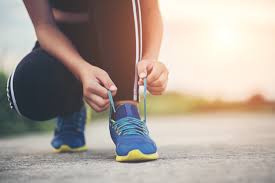
Now, real quick, before moving on, let’s go over tying our shoes! Elementary, I know, but humor me? There’s a million different patterns and knots you can explore through Google and Pinterest, each claiming to enhance your performance or reduce pain or support that one thing that sometimes twinges a bit. I won’t be going into all of that, though I will say I’ve always just done a simple lace-up and never had any problems! No, what I’m talking about is the cinching. For some reason, when we tie our shoes getting ready for a run or a workout, we tend to pull the laces way too tight, as if there’s a dramatic training montage happening!
If you look at the top of your foot, you can see blue lines running just under the skin. These veins and arteries are very close to the surface, and when we cinch our shoes too tightly, we effectively create a tourniquet and cut off blood flow in the area. If you get the painful pins-and-needles feeling during your run, or the top of your foot is irritated, it’s likely because you tied your shoes too tight. Laces should be snug, not strangling. After you’ve taken up the loose material but before you knot the laces, wiggle and flex you foot a bit. This will mimic the movement and range of motion you’ll need while running and help ensure the laces are loose enough to run comfortably!.
Focus on Form
Encouraging the body to move the way it was designed to! Just like any other system with moving parts, the human body is designed to move and work in certain ways. Poor form hinders the body’s capabilities and can actually cause us to work harder. Improving your running form can help you run faster, more efficiently and comfortably, and with less stress on your body to reduce injury risk. Here are the Top Five Threats and Remedies to Good Running Form:
- Midfoot Strike Striking the ground with the midfoot promotes a balance running position and minimizes irregularities that can cause friction. Be sure to always land light and avoid pounding, which can cause knee pain and shin splints. Try to keep footfall in line with hips to avoid over-striding.
- Hands at the Waist Many people run with their shoulders and hands tensed up, keeping their hands at the level of their chest. This can actually cause more tension and pain in the back muscles, and hinders breathing. Relax your shoulders and let your hands swing comfortably by your waist, almost brushing your hips.
- Rotate at Shoulders Any fellow sprinter knows we were trained to keep everything squared and at 90-degree angles, swinging our arms from the shoulder. When tired, people tend to create the motion either from moving their elbows, which is ineffectual, or rotating at the torso, which will take up a lot of your energy without any great payout. Moving our arms back and forth from the shoulder joint provides the best momentum to keep us moving forward.
- Lean at Ankle Flex at your ankles to keep your weight slightly bent forward rather than bending at the waist. This is good for gaining momentum during periods of acceleration.
- Posture Keep your posture in line and erect, with head up, back straight, and shoulders level and squared. Posture is typically the first to go when we get tired, so check it regularly during your run! If you feel yourself starting to slouch, pull your shoulders back and poke your chest out a bit.

A large part of the importance of good running form is the physical biomechanics of it. Moving the body in these ways will help it perform efficiently, comfortably, and without great risk of injury. However, good running form can also effect your respiratory system.
When we get tired during a run, we tend to slouch and cave our shoulders forward. This constricts our chest cavity and makes it harder to draw breath. You’ll breathe a lot easier if you keep your shoulder squared and relaxed and hold your posture straight!
Similar to our form slipping when we’re tired during a run, we often have a tendency to live for the finish line and then stop dead. Hunched over, hands on knees, breathing heavy. Again, this constricts our chest and inhibits air flow, right when we need it most! Push yourself to remain upright when you finish a run and walk a bit with your shoulders back and hands resting on your head to open up your chest and allow air to easily enter your lungs.

Just Breathe
Just like how our form degrades when we get tired, we also tend to lose our breath and breathe heavily through our mouths. This is not a great technique because it does not supply adequate oxygen required by our muscles. Instead, push yourself to maintain regular, balanced breaths through Aerobic Breathing.
Aerobic breathing is a technique most effective during aerobic activities, such as jogging, running, bicycling, sports, etc. The idea it to breathe deeply through the nose and exhale evenly through the mouth. This method is preferable to mouth breathing for a number of reasons:
- Quality of Airflow Thinking about the anatomy of the respiratory tract, there are two ways air can get to our lungs: through the mouth into the trachea, or through nose, past the nares, into the pharynx, and down into the trachea. Clearly, it’s a longer path through the nose, which is good for the quality of air reaching our lungs. That longer path allows our respiratory tract more time to warm the air entering the trachea, avoiding that burning sensation in the throat and lungs when cold air is quickly breathed in. Also, there are tiny hairs lining the nasal cavity that act as a filter, cleansing the air of dust and particles that could cause us harm if they reached the lungs.
- Oxygen/Carbon-Dioxide Balance A not as commonly thought of benefit of aerobic breathing is the maintenance of the correct balance of oxygen and carbon dioxide in our blood. Contradictory to popular belief, it’s actually the build-up of carbon dioxide in our blood that drives our breathing rate, rather than the depletion of oxygen. This encourages us to make long exhales through the mouth to quickly expel the carbon-dioxide, while only drawing in quick breaths. This leads to not enough oxygen in our blood to sustain our working muscles, and can result in fatigue, cramps, and even dizziness and light-headedness if not balanced. Breathing through the nose will force you to take deeper, more even breaths that provide adequate oxygen to your blood.
- Deep+Even Breaths Breathing through the mouth will produce short, shallow, and infrequent breaths (chest breathing). This is the cause of the those pesky side cramps you get mid run. If you feel a stitch beginning in your side, try slowing your pace and focusing on your breathing for a bit, drawing long, slow breaths in through the nose, deep into the belly, and even exhalations through the mouth.
Aim to inhale for 3 steps and exhale for 3 steps during easy jogs (3:3). As you increase your intensity, you can also increase frequency of breaths, ie Medium-Intensity: 2:2 and Max-Intensity: 1:1.

Joys of Noise
No divider has ever split runners quite as much as the old silence vs. sound mentality debate. Some say that cranking up their favorite song gets them in a good head-space to increase their tempo and push themselves faster, while others argue that running with any kind of noise takes away from the simplicity and mentality of the activity.
Now, I’m not here to push anyone into one camp or the other, and here’s why: it’s your run! Unless you’re professionally training for a competition, chances are that you’re racking up the miles because you want to. You like being healthy and active, you enjoy your time pounding the pavement, you want to enjoy a happy+healthy life and reap the benefits of physical activity! This is your time, and how you want to spend it is completely up to you. There is no data backing either the silent ninjas or the music lovers as the better runners. So if you want to go radio silence for those miles and connect with the world around you, that’s awesome! Or, if you want to plug in the headphones and lose yourself for a bit, that’s okay too!
I will say that personally, I’m a big fan of the sound runners’ camp. Nothing gets me more amped than the perfect song coming on at the perfect time to make me feel like I’m flying! But what should we listen to while running?
Whether it’s rock, hip-hop, or even classical, the style of music doesn’t matter. It’s the beats per minute (bpm) of the song. What gets us pumped during a run is the song with a high bpm. Why? Because we can then match our steps per minute (spm) to the song and that’s what drives our faster pace. If you’re a fan of that rush when a fast song comes on, I recommend checking out Weav Run. Weav Run is an adaptive music app that reconstructs songs to match the bpm instantaneously with the runner’s stpm. So when you start to increase your speed, your music is always right there with you!

Be sure to give some thought to what you want to listen to before heading out the door. There’s nothing worse than being dealt a bad batch of songs and trying to readjust during the run! I like a variety to my music and get bored easily if I hear to the same songs over and over, so I typically listen to my Pandora workout station, built from Imagine Dragons, X Ambassadors, Bastille, and Panic! at the Disco! The problematic side of Pandora, though, is you can’t control what’s coming up next. So if you know you’re the type that can have a mile be ruined by a bad song, try using Spotify or iTunes to build a playlist of your favorite workout songs ahead of time for miles of awesomeness!
Not a fan of listening to music while working out but don’t want to face the silence? Never fear! More and more runners are listening to podcasts to keep their mind occupied during the long miles. There are a number of podcasts available, often free and frequently updated. There’s also a large variety of health and fitness topics, including running, if you need a little extra motivation for why you’re putting your body through this run! Check out this list of 13 Awesome Podcasts to Get You Through a Long Run for ideas!

When it comes down to it, running is the simplest form of exercise around. it’s cheap, easy, and a great weight bearing activity that can strengthen our joints and bones, reduces the risk of heart disease, and adds years to our lives! All you need is a pair of good shoes, some open space, and to remember not to get too caught up in the details. Keep it simple, keep it healthy, keep it happy, keep it you!


 bFit bFearless